Why Your Hockey League Should Switch to Digital Game Sheets

Why Your Hockey League Should Switch to Digital Game Sheets
Content
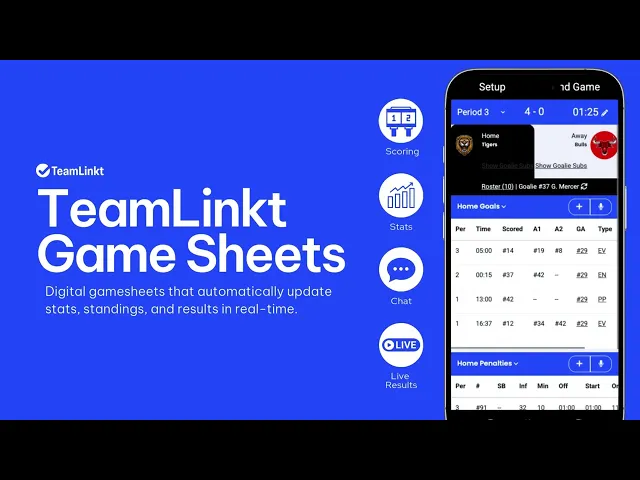
A digital game sheet replaces the clipboard, the pen, and the end-of-night scramble to figure out whose handwriting that penalty note is in. Goals, assists, penalty minutes, and goalie changes get entered on a tablet or phone as they happen on the bench, and the record syncs the moment the final buzzer goes, instead of waiting for someone to drive the paper copy home and type it up later.
For a hockey league running dozens of games a weekend across multiple divisions, that difference shows up fast: fewer disputed scores, fewer missing penalty records, and a lot less time spent chasing down whoever had the clipboard last.
Below: why paper score sheets break down at scale, what happens inside TeamLinkt’s digital game sheets on game day, what changes the instant a game ends, and what it costs to switch.
See How TeamLinkt Simplifies Your Organization
Get a tailored walkthrough of how your organization can manage its operations in one connected platform.
See How TeamLinkt Simplifies Your Organization
Get a tailored walkthrough of how your organization can manage its operations in one connected platform.
What Makes Hockey Scorekeeping So Error-Prone?
Paper scorekeeping fails for the same reason most manual processes fail at volume: it depends on one person, under time pressure, writing legibly and correctly, every single time, with no second check until someone tries to read it later. A rushed penalty note, a missed roster check-in, or a scoresheet left in a coach’s bag turns into a disputed result, a missing goal or assist, or a call to the league office days after the fact.
Three things compound the problem. First, every new volunteer scorekeeper has to learn the league’s paper format from scratch, usually by watching someone else do it once. Second, nothing gets double-checked in real time, so an error sits undetected until someone tries to reconcile standings at the end of the week. Third, the finished sheet still has to be collected, read, and manually entered into whatever system tracks standings, which is its own separate chance to introduce a mistake.
How TeamLinkt's Digital Hockey Game Sheets Work
A scorekeeper opens the game on a tablet or phone, the roster and officials are already loaded in, and they record goals, assists, penalties, and goalie changes as the play happens. Roster verification is a tap, not a read-aloud check against a clipboard, so puck drop isn’t held up even when a few players show up late. Attendance gets marked the same way: a tap per player, logged as it happens, so the league has an accurate record of who actually dressed for the game without reconstructing it from memory afterward.
Penalty management happens inside the same entry, not as a separate step afterward. A scorekeeper records the infraction type and minutes during the game, and that entry becomes part of the player’s penalty and suspension history automatically. An admin reviewing a suspension dispute two weeks later pulls up a record rather than asking three people what they remember from that night.
Training Volunteer Scorekeepers in Minutes, Not Seasons
Most hockey leagues run on volunteer scorekeepers who show up once a week and need to be useful within their first shift.
Egor, a Hockey Calgary volunteer scorekeeper, described their first time on TeamLinkt’s digital game sheets this way: “I volunteered yesterday as a scorekeeper, and it was my first time using electronic scoresheets.”
The interface is built around the same decisions a scorekeeper is already making on paper, goal, assist, penalty, which is what makes a first-time volunteer usable the same night rather than needing a season of shadowing an experienced one. That turnaround matters directly for how you staff game days without burning out the same two or three people every weekend.
What Happens the Moment a Game Ends?
The instant a scorekeeper closes out a game, the result pushes live: standings update, the box score posts, and the result shows up in the team app and on the league website without anyone exporting a file or typing a second entry. Parents and players checking from the stands see the final score and penalty summary before the team bus leaves the rink, not two days later when someone gets around to updating a spreadsheet.
That same sync carries through the whole season, with every game added to the same running record. Leaderboards update automatically, player and team profiles carry the season’s goals, assists, and penalty minutes forward, and anyone checking a scheduling page for next week’s matchup sees the current standings sitting right next to it. Coaches and officials sign off digitally at the end of the game, so the finished record is complete and dated the moment it’s closed, with nothing left to collect or reconcile later.
How Game Sheets Fit Into the Rest of Your Season
Game sheets don’t sit in their own silo. Rosters loaded into a game sheet come from the same registration data that built your divisions in the first place, so a scorekeeper isn’t retyping a player list that already exists somewhere else in the system. Game times and rink locations pull from the same schedule parents already check, so nobody’s reconciling two separate calendars to figure out which arena a Tuesday night game is at.
A scorekeeping app bought on its own is a second system to pay for, log into, and maintain just to run the scoring side of game day. When the game sheet is part of one platform instead, a commissioner configures divisions and rosters once, and that same data carries through to scheduling, communication, and the game sheet a volunteer opens on Saturday morning.
What It Costs to Make the Switch
TeamLinkt’s digital game sheets come with the first 100 games at no cost, then $2 per game after that, with no separate fee for the team app parents and coaches use to follow results. For a hockey league weighing what a digital scorekeeping system costs against what it saves in admin time and corrected errors, that’s worth running the numbers on directly, and TeamLinkt publishes a full feature and pricing comparison against the leading dedicated hockey scorekeeping app for exactly that reason.
Task | Paper Scoresheet | TeamLinkt Digital Game Sheet |
New volunteer training | Shadow an experienced scorekeeper for a game or more | Usable the same shift, same night |
Error checking | Caught only when someone reconciles standings later | Flagged by guardrails during entry |
Results visible to parents | After the sheet is collected and typed up | The moment the scorekeeper closes the game |
Penalty and suspension history | Reconstructed from memory or old sheets | Pulled up as a standing record |
Season-long stats and standings | Reassembled by hand each week | Updated automatically after every game |
Stay Connected
Leave your information below for monthly tips to grow and streamline your sports organization.
Stay Connected
Leave your information below for monthly tips to grow and streamline your sports organization.
What This Looks Like for a Real League
North Dakota Amateur Hockey Association adopted TeamLinkt’s digital game sheets in fall 2023 and rolled the tool out across its player base that same season. Ryan Griggs of NDAHA pointed to the thing every admin worries about before a rollout like this: whether volunteers and parents who have never used the tool before can handle it under game-day pressure. His answer: “Parents have never had a problem figuring out how to do it.”
A rollout like this succeeds or fails on one thing: whether a parent who has never used the tool before can sit down at a rink on a Tuesday night and get through a game without calling the league office.
Frequently Asked Questions
Do volunteer scorekeepers need any technical background to use digital game sheets?
No. The interface mirrors what a scorekeeper already tracks on paper: who scored, who assisted, and what penalty was called, so most volunteers are comfortable from their first shift. North Dakota Amateur Hockey Association, which rolled the tool out to parents and volunteers starting in fall 2023, reports parents haven’t had trouble figuring it out.
What happens if the internet drops out mid-game at the rink?
Entries made on the device are held locally and sync once the connection is back, so a scorekeeper can keep entering goals and penalties through a dead spot without losing the game record.
Does this work for house league as well as rep and tournament hockey?
Yes. The same digital game sheet handles a Tuesday night house league game and a weekend rep tournament, with the same roster, penalty, and results tracking either way.
Who can see the results after a game ends?
Results sync automatically to the team app and the league website the moment the scorekeeper closes out the game, so parents, players, and fans see the final score and stats without the league exporting or posting anything separately.
What does it cost to switch from paper score sheets?
The first 100 games are at no cost, then it’s $2 per game, with the team app included at no extra cost. A full feature and pricing comparison against the leading dedicated scorekeeping app is available for leagues weighing the switch.
Do coaches and officials need to sign off on the game sheet?
Yes, digitally. Coaches and officials sign off on the device at the end of the game, so the finished record is complete and dated without a paper copy to collect afterward.
One Game Sheet, Not Three Systems
The real payoff of digital game sheets shows up in what stops happening once the scoresheet stops being the single point of failure for a weekend’s worth of games. Nobody drives a paper copy across town. Nobody squints at a penalty note to settle a dispute three days later. Nobody retypes Saturday’s results into a spreadsheet on Sunday night.
The same system runs this way for other sports too. If your association also runs soccer, digital score sheets solve the same problem there, with the same roster and results syncing to one place instead of a separate process per sport.
If your hockey league is still running game day on a clipboard and a shared spreadsheet, the fastest way to see the difference is to watch a weekend go by without any of that follow-up work. Book a demo and see how TeamLinkt’s digital game sheets fit into the rest of your season, from registration through the final standings.

Vince Ocampo
Marketing Specialist | TeamLinkt
Vince is a Marketing Specialist at TeamLinkt focused on content strategy, SEO, and AI-driven search in the youth sports space.
Vince Ocampo
Marketing Specialist | TeamLinkt
Vince is a Marketing Specialist at TeamLinkt focused on content strategy, SEO, and AI-driven search in the youth sports space.
Get Started Now
Create a free account and transform the way you manage your Sports Organization.
Your Next Season Starts Here
Join thousands of sports organizations that manage registration, scheduling, and communication in one place.
Your Next Season Starts Here
Join thousands of sports organizations that manage registration, scheduling, and communication in one place.
Sports
sports_basketball
sports_football
sports_baseball
sports_soccer
ice_skating
sports_baseball
sports_volleyball
sports_baseball
sports_rugby
sports_hockey
sports_cricket
pool
sports_gymnastics
star_shine
sports_esports
sports_gymnastics
sports_martial_arts
sports
artist
Programs
Product
Enroll & Register
Plan & Schedule