Why Your League's Website Should Run on the Same Data as Everything Else

Why Your League's Website Should Run on the Same Data as Everything Else
Content
A sports organization's website is usually out of date the moment someone hits publish. Not because anyone did a bad job building it, but because the moment a game gets rescheduled, a roster changes, or standings update, that website doesn't know. Someone has to go back in and tell it, and on a volunteer-run team, that someone usually has three other things to do first.
This isn't really a website problem. It's a data problem. A youth sports website builder built on top of your registration and scheduling data doesn't have this problem, because there's nothing to go back and update. The site just reads what's already true.
Most organizations don't choose to run their website separately from their season. It happens by accumulation: a website gets built one year, a registration system gets adopted another year, a scheduling tool gets added later because the spreadsheet stopped working, and nobody ever goes back and connects the three. Each piece works fine on its own. None of them talk to each other, so a human has to.
A sports organization's website is usually out of date the moment someone hits publish. Not because anyone did a bad job building it, but because the moment a game gets rescheduled, a roster changes, or standings update, that website doesn't know. Someone has to go back in and tell it, and on a volunteer-run team, that someone usually has three other things to do first.
This isn't really a website problem. It's a data problem. A youth sports website builder built on top of your registration and scheduling data doesn't have this problem, because there's nothing to go back and update. The site just reads what's already true.
Most organizations don't choose to run their website separately from their season. It happens by accumulation: a website gets built one year, a registration system gets adopted another year, a scheduling tool gets added later because the spreadsheet stopped working, and nobody ever goes back and connects the three. Each piece works fine on its own. None of them talk to each other, so a human has to.
See How TeamLinkt Simplifies Your Organization
Get a tailored walkthrough of how your organization can manage its operations in one connected platform.
See How TeamLinkt Simplifies Your Organization
Get a tailored walkthrough of how your organization can manage its operations in one connected platform.
Why your website falls behind the moment you hit publish
A website built separately from your registration and scheduling tools is a snapshot, not a live view. The moment you publish it, it starts drifting away from what's actually happening in your organization: a new roster addition, a moved game time, an updated standings table- none of it reaches the site unless a person manually carries it over. The fix isn't a reminder system or a more disciplined volunteer. It's removing the manual step entirely by building the site on the same data as everything else.
That gap matters more than it sounds like it should. Parents aren't casually checking in on their kid's season. According to a 2025 Aspen Institute Project Play survey of nearly 1,850 youth sports parents, the average sports parent spends 3 hours and 23 minutes on every day their child has a practice or game, including time spent communicating with coaches and other parents. Every one of those parents has a real stake in the website showing the correct time, the correct field, and the correct score. A stale site means wrong information going to people who are already stretched thin.
Why your website falls behind the moment you hit publish
A website built separately from your registration and scheduling tools is a snapshot, not a live view. The moment you publish it, it starts drifting away from what's actually happening in your organization: a new roster addition, a moved game time, an updated standings table- none of it reaches the site unless a person manually carries it over. The fix isn't a reminder system or a more disciplined volunteer. It's removing the manual step entirely by building the site on the same data as everything else.
That gap matters more than it sounds like it should. Parents aren't casually checking in on their kid's season. According to a 2025 Aspen Institute Project Play survey of nearly 1,850 youth sports parents, the average sports parent spends 3 hours and 23 minutes on every day their child has a practice or game, including time spent communicating with coaches and other parents. Every one of those parents has a real stake in the website showing the correct time, the correct field, and the correct score. A stale site means wrong information going to people who are already stretched thin.
What a volunteers webmaster actually has to keep in sync, manually
On a disconnected website, one person (often a volunteer, often the same person juggling three other admin jobs) is responsible for noticing every change somewhere else and re-entering it on the site. In practice, that means:
Copying new rosters over every time registration closes, usually by exporting a list from one system and re-typing or re-pasting it into whatever page builder the website runs on.
Re-typing schedule changes after they've already been announced somewhere else, often a day or more after the team app or a group text already told parents the real time.
Manually updating standings and scores, usually a day or two after the games actually happened, which means the website is correct for most of the week and wrong for the part of it people check most.
Keeping the website's team pages in sync with whatever the league's actual divisions look like that season, including new teams, renamed divisions, and rosters that shift during the first few weeks of registration.
None of these are hard tasks individually. The problem is that there are dozens of them every season; they're never done once, and they all depend on one person remembering to do them in the right order.
The real cost of "someone will update it later"
"Someone will update it later" is where outdated information actually comes from. Volunteers aren't the problem; manual re-entry is a genuinely bad method for keeping information accurate, and the research on this is specific. A peer-reviewed study by Barchard and Pace on data entry methods found that visual-checking, the normal way a volunteer "proofreads" a manual update, produced 29 to 58 percent more errors than double-entry verification. Most of those errors don't look wrong. They just sit there until a parent shows up at the wrong field.
It also costs the one thing volunteer admins have the least of: time.
TeamLinkt customers report saving an average of 11 hours of admin time per week running registration, scheduling, and their website on one connected platform instead of three separate ones. That number isn't about any single update taking long. It's what happens when the same four or five facts (who's on the roster, when the game is, what the score was) get typed into second place, every single week, for an entire season.
What a volunteers webmaster actually has to keep in sync, manually
On a disconnected website, one person (often a volunteer, often the same person juggling three other admin jobs) is responsible for noticing every change somewhere else and re-entering it on the site. In practice, that means:
Copying new rosters over every time registration closes, usually by exporting a list from one system and re-typing or re-pasting it into whatever page builder the website runs on.
Re-typing schedule changes after they've already been announced somewhere else, often a day or more after the team app or a group text already told parents the real time.
Manually updating standings and scores, usually a day or two after the games actually happened, which means the website is correct for most of the week and wrong for the part of it people check most.
Keeping the website's team pages in sync with whatever the league's actual divisions look like that season, including new teams, renamed divisions, and rosters that shift during the first few weeks of registration.
None of these are hard tasks individually. The problem is that there are dozens of them every season; they're never done once, and they all depend on one person remembering to do them in the right order.
The real cost of "someone will update it later"
"Someone will update it later" is where outdated information actually comes from. Volunteers aren't the problem; manual re-entry is a genuinely bad method for keeping information accurate, and the research on this is specific. A peer-reviewed study by Barchard and Pace on data entry methods found that visual-checking, the normal way a volunteer "proofreads" a manual update, produced 29 to 58 percent more errors than double-entry verification. Most of those errors don't look wrong. They just sit there until a parent shows up at the wrong field.
It also costs the one thing volunteer admins have the least of: time.
TeamLinkt customers report saving an average of 11 hours of admin time per week running registration, scheduling, and their website on one connected platform instead of three separate ones. That number isn't about any single update taking long. It's what happens when the same four or five facts (who's on the roster, when the game is, what the score was) get typed into second place, every single week, for an entire season.
It also costs you in search, not just in accuracy
There's a second, less obvious cost to a website that only gets touched during the off-season: search engines and AI answer tools both treat freshness as a signal. A roster page that hasn't changed since August, next to a schedule page that still shows last season's dates, reads to Google (and to a parent searching "when does the U12 season start") as a site that isn't actively maintained. A website built on live data doesn't need a content calendar to stay current, every roster addition and schedule update is itself a freshness signal, generated automatically by the season actually happening.
It also costs you in search, not just in accuracy
There's a second, less obvious cost to a website that only gets touched during the off-season: search engines and AI answer tools both treat freshness as a signal. A roster page that hasn't changed since August, next to a schedule page that still shows last season's dates, reads to Google (and to a parent searching "when does the U12 season start") as a site that isn't actively maintained. A website built on live data doesn't need a content calendar to stay current, every roster addition and schedule update is itself a freshness signal, generated automatically by the season actually happening.
What changes when your site reads from the same data as your platform
A connected website doesn't ask anyone to remember anything. Registration updates the roster the moment a family signs up, including real-time roster syncing so the site is never cross-referencing a separate list. Scheduling changes sync instantly to the website and the Team App the moment a coach moves a game. None of it is a second step. It's the same data, shown in a second place.
Disconnected website | Connected website | |
|---|---|---|
Roster updates | Re-typed after every registration | Synced automatically the moment someone registers |
Schedule changes | Updated manually, often after the fact | Reflected instantly across site and app |
Standings and scores | Entered by hand, usually delayed | Updated in real time as games are recorded |
Who's responsible | One volunteer webmaster | No one, the data already lives in the platform |
That last row is the actual point. "Connected by Default" isn't a feature on a list, it's the difference between a website that needs a person standing behind it and one that doesn't.
What changes when your site reads from the same data as your platform
A connected website doesn't ask anyone to remember anything. Registration updates the roster the moment a family signs up, including real-time roster syncing so the site is never cross-referencing a separate list. Scheduling changes sync instantly to the website and the Team App the moment a coach moves a game. None of it is a second step. It's the same data, shown in a second place.
Disconnected website | Connected website | |
|---|---|---|
Roster updates | Re-typed after every registration | Synced automatically the moment someone registers |
Schedule changes | Updated manually, often after the fact | Reflected instantly across site and app |
Standings and scores | Entered by hand, usually delayed | Updated in real time as games are recorded |
Who's responsible | One volunteer webmaster | No one, the data already lives in the platform |
That last row is the actual point. "Connected by Default" isn't a feature on a list, it's the difference between a website that needs a person standing behind it and one that doesn't.
How TeamLinkt's Website Builder puts this into practice
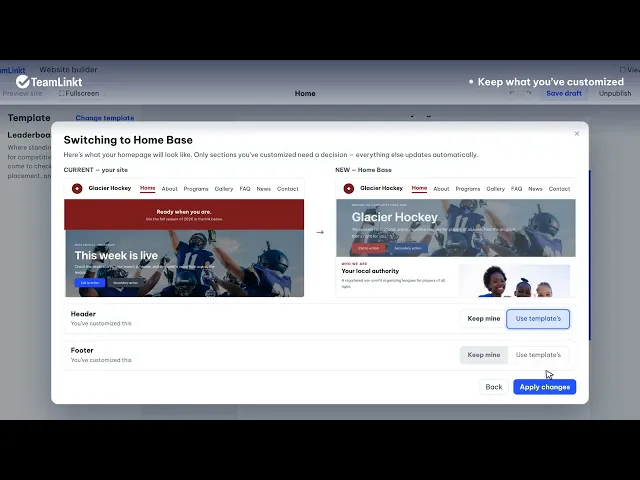
This isn't a hypothetical architecture, it's how TeamLinkt's Website Builder is actually built. The site reads directly from Registration, Scheduling, and the Team App instead of keeping a separate copy of any of it. A new sign-up updates the roster. A moved game updates the schedule shown on the site and the app at the same time. A recorded score updates standings without anyone opening the website at all.
The building side works the same way admins already expect from the rest of TeamLinkt:
Sport-specific templates instead of a generic layout you have to force to fit a season.
Drag-and-drop page editing with instant undo and autosave, no developer, no waiting.
Content blocks (grids, tables, tabs, sliders) for the parts of a season that don't fit neatly into a standard template, a sponsor section, a fundraiser page, a tournament bracket.
None of that building work touches the data underneath it. You're designing how the season looks, not maintaining what it says.
How TeamLinkt's Website Builder puts this into practice
This isn't a hypothetical architecture, it's how TeamLinkt's Website Builder is actually built. The site reads directly from Registration, Scheduling, and the Team App instead of keeping a separate copy of any of it. A new sign-up updates the roster. A moved game updates the schedule shown on the site and the app at the same time. A recorded score updates standings without anyone opening the website at all.
The building side works the same way admins already expect from the rest of TeamLinkt:
Sport-specific templates instead of a generic layout you have to force to fit a season.
Drag-and-drop page editing with instant undo and autosave, no developer, no waiting.
Content blocks (grids, tables, tabs, sliders) for the parts of a season that don't fit neatly into a standard template, a sponsor section, a fundraiser page, a tournament bracket.
None of that building work touches the data underneath it. You're designing how the season looks, not maintaining what it says.
Stay Connected
Leave your information below for monthly tips to grow and streamline your sports organization.
Stay Connected
Leave your information below for monthly tips to grow and streamline your sports organization.
How do parents actually find out about schedule changes?
Most parents find out about a schedule change the same way they find out about anything else in their kid's season: whatever channel their league actually uses consistently, whether that's the team app, a group text, or the website, if any of those three disagrees with the others, someone ends up at the wrong field at the wrong time. A connected setup removes that disagreement by making sure the website, the app, and the schedule are reading from one source instead of three.
This is also why "just post it on the team app" isn't a full fix on its own. The Team App is where most families check first, which is exactly why it has to agree with the website rather than quietly replace it. A parent who gets a push notification about a time change, then opens the website later to confirm the field, needs to see the same answer in both places, a data problem first, no matter how good the communication channel is.
How do parents actually find out about schedule changes?
Most parents find out about a schedule change the same way they find out about anything else in their kid's season: whatever channel their league actually uses consistently, whether that's the team app, a group text, or the website, if any of those three disagrees with the others, someone ends up at the wrong field at the wrong time. A connected setup removes that disagreement by making sure the website, the app, and the schedule are reading from one source instead of three.
This is also why "just post it on the team app" isn't a full fix on its own. The Team App is where most families check first, which is exactly why it has to agree with the website rather than quietly replace it. A parent who gets a push notification about a time change, then opens the website later to confirm the field, needs to see the same answer in both places, a data problem first, no matter how good the communication channel is.
What to look for in a connected website builder
If you're evaluating whether your current website setup (or a new one) is actually solving this, a few questions cut through most of the marketing language:
Does a schedule change on the platform show up on the website without anyone touching the site? If the answer involves a second login or a second step, it's not actually connected, it's just two systems that happen to look similar and still need a person in the middle.
Does registering a new player update the website's roster automatically? TeamLinkt's Registration includes a smart importer and real-time roster syncing specifically so a new sign-up doesn't require manually cross-referencing a second list before the website reflects it.
Is the website built with sport-specific templates, or does your admin have to force a generic layout to fit a season schedule and roster pages? A generic builder can display information. It can't organize itself around a season, a division structure, or a roster the way a purpose-built one can, which usually means more manual layout work every time something changes.
Where do standings and scores actually come from? If scores get entered once in a game sheet and the website shows them automatically, that's connected. If someone updates the standings page by hand afterward, usually from memory or a text thread, that's the same old problem with a new coat of paint.
What happens when your season ends and the next one starts? A disconnected site usually needs a manual reset, archiving last season's teams and rebuilding new ones. A connected site reflects the new season the moment it's created on the platform, since the website was never a separate project to begin with.
What to look for in a connected website builder
If you're evaluating whether your current website setup (or a new one) is actually solving this, a few questions cut through most of the marketing language:
Does a schedule change on the platform show up on the website without anyone touching the site? If the answer involves a second login or a second step, it's not actually connected, it's just two systems that happen to look similar and still need a person in the middle.
Does registering a new player update the website's roster automatically? TeamLinkt's Registration includes a smart importer and real-time roster syncing specifically so a new sign-up doesn't require manually cross-referencing a second list before the website reflects it.
Is the website built with sport-specific templates, or does your admin have to force a generic layout to fit a season schedule and roster pages? A generic builder can display information. It can't organize itself around a season, a division structure, or a roster the way a purpose-built one can, which usually means more manual layout work every time something changes.
Where do standings and scores actually come from? If scores get entered once in a game sheet and the website shows them automatically, that's connected. If someone updates the standings page by hand afterward, usually from memory or a text thread, that's the same old problem with a new coat of paint.
What happens when your season ends and the next one starts? A disconnected site usually needs a manual reset, archiving last season's teams and rebuilding new ones. A connected site reflects the new season the moment it's created on the platform, since the website was never a separate project to begin with.
FAQ
Do I have to re-enter my schedule on my website after I build it in TeamLinkt?
No. Once your season is scheduled in TeamLinkt, the website reads from that same schedule. A game time change on the scheduling side appears on the website and the Team App without a second update.
What happens to my website when I add a new team or division mid-season?
New teams and divisions created in your platform show up on the site's team pages automatically, since the pages are generated from your actual organizational structure, not built by hand.
Does a connected website still let me customize how it looks?
Yes. Sport-specific templates and page-building tools still let you control branding, colors, and layout. What's different is that the content underneath, rosters, schedules, standings, stays current without a manual step.
What if I'm switching from a platform that doesn't connect to a website at all?
That's a common starting point, and it's worth reading what actually happens to your website when you switch platforms before assuming a switch means rebuilding from scratch.
Does this replace needing someone to manage the website at all?
It removes the re-entry work, not the judgment calls, someone still decides what a new page says or what photos go up. What disappears is the part where someone has to remember to copy a schedule change over by hand.
FAQ
Do I have to re-enter my schedule on my website after I build it in TeamLinkt?
No. Once your season is scheduled in TeamLinkt, the website reads from that same schedule. A game time change on the scheduling side appears on the website and the Team App without a second update.
What happens to my website when I add a new team or division mid-season?
New teams and divisions created in your platform show up on the site's team pages automatically, since the pages are generated from your actual organizational structure, not built by hand.
Does a connected website still let me customize how it looks?
Yes. Sport-specific templates and page-building tools still let you control branding, colors, and layout. What's different is that the content underneath, rosters, schedules, standings, stays current without a manual step.
What if I'm switching from a platform that doesn't connect to a website at all?
That's a common starting point, and it's worth reading what actually happens to your website when you switch platforms before assuming a switch means rebuilding from scratch.
Does this replace needing someone to manage the website at all?
It removes the re-entry work, not the judgment calls, someone still decides what a new page says or what photos go up. What disappears is the part where someone has to remember to copy a schedule change over by hand.
The real test for any sports website
The test for whether a sports organization's website is actually working isn't how it looks on launch day. It's still accurate in week six of the season, after four schedule changes, two new registrations, and a tournament that got moved to a different weekend. A website connected to the same data as your registration and scheduling doesn't pass that test through effort. It passes because there was never a separate copy of the truth to fall out of sync with in the first place.
That's a different question than "does our website look good," and it's worth asking that specifically. A league can have a beautifully designed site that's wrong about next week's game time, and a plain one that's always correct. Parents forgive plain. They don't forgive wrong, especially when they've just spent part of their day driving to the location the website told them was right.
If your league's website is still a separate project from the rest of your season, see how TeamLinkt's Website Builder connects to registration and scheduling by default, and what it looks like when your site stops needing anyone to maintain it manually.
The real test for any sports website
The test for whether a sports organization's website is actually working isn't how it looks on launch day. It's still accurate in week six of the season, after four schedule changes, two new registrations, and a tournament that got moved to a different weekend. A website connected to the same data as your registration and scheduling doesn't pass that test through effort. It passes because there was never a separate copy of the truth to fall out of sync with in the first place.
That's a different question than "does our website look good," and it's worth asking that specifically. A league can have a beautifully designed site that's wrong about next week's game time, and a plain one that's always correct. Parents forgive plain. They don't forgive wrong, especially when they've just spent part of their day driving to the location the website told them was right.
If your league's website is still a separate project from the rest of your season, see how TeamLinkt's Website Builder connects to registration and scheduling by default, and what it looks like when your site stops needing anyone to maintain it manually.

Vince Ocampo
Marketing Specialist | TeamLinkt
Vince is a Marketing Specialist at TeamLinkt focused on content strategy, SEO, and AI-driven search in the youth sports space.
Vince Ocampo
Marketing Specialist | TeamLinkt
Vince is a Marketing Specialist at TeamLinkt focused on content strategy, SEO, and AI-driven search in the youth sports space.
Get Started Now
Create a free account and transform the way you manage your Sports Organization.
Your Next Season Starts Here
Join thousands of sports organizations that manage registration, scheduling, and communication in one place.
Your Next Season Starts Here
Join thousands of sports organizations that manage registration, scheduling, and communication in one place.
Sports
sports_basketball
sports_football
sports_baseball
sports_soccer
ice_skating
sports_baseball
sports_volleyball
sports_baseball
sports_rugby
sports_hockey
sports_cricket
pool
sports_gymnastics
star_shine
sports_esports
sports_gymnastics
sports_martial_arts
sports
artist
Programs
Product
Enroll & Register
Plan & Schedule