How to Create a Youth Sports Schedule (Step-by-Step Guide for League Organizers)

How to Create a Youth Sports Schedule (Step-by-Step Guide for League Organizers)
Content
Learning how to create a youth sports schedule might seem straightforward at first, but most league organizers quickly realize how complex the process can become.
Balancing teams, field availability, coaches, referees, and parent expectations can quickly make scheduling one of the most challenging parts of running a league. But with the right structure, organizers can create fair, organized schedules without constantly rebuilding them.
In this article, you will learn how to properly structure your league before scheduling, the most common scheduling formats used in youth sports, and how to create and manage schedules far more efficiently.
Learning how to create a youth sports schedule might seem straightforward at first, but most league organizers quickly realize how complex the process can become.
Balancing teams, field availability, coaches, referees, and parent expectations can quickly make scheduling one of the most challenging parts of running a league. But with the right structure, organizers can create fair, organized schedules without constantly rebuilding them.
In this article, you will learn how to properly structure your league before scheduling, the most common scheduling formats used in youth sports, and how to create and manage schedules far more efficiently.
See How TeamLinkt Simplifies League Scheduling
Get a walkthrough of how your organization can create schedules, manage teams, and communicate updates from one connected platform.
See How TeamLinkt Simplifies League Scheduling
Get a walkthrough of how your organization can create schedules, manage teams, and communicate updates from one connected platform.
Why Youth Sports Scheduling Is More Complex Than It Looks
At a glance, building a youth sports schedule can seem like a simple task: list the teams, assign dates, and fill in game slots. In reality, scheduling quickly becomes a complex puzzle once real-world variables start to pile up.
League organizers often have to balance multiple constraints at the same time. Field availability may vary week to week, referees may only be available on certain days, and coaches or volunteers might be managing multiple teams across different divisions. On top of that, organizers must consider school calendars, holidays, and potential weather disruptions, all while trying to create a schedule that feels fair for every team.
Even small scheduling decisions can have ripple effects. For example, giving one team too many early-morning games or too many back-to-back matchups can create frustration for players, parents, and coaches. Over time, these small imbalances can lead to complaints and extra administrative work for league organizers.
Many leagues also start with basic formats such as a round-robin structure, where each team plays every other team at least once. If you're unfamiliar with how this format works, it can help to understand the fundamentals of a round robin tournament before building your schedule.
Learn How To Run A Round Robin Tournament
This complexity is one of the main reasons many leagues struggle when trying to manage schedules manually in spreadsheets. As the number of teams, divisions, and game slots grows, even well-organized spreadsheets can become difficult to maintain and adjust. Today, many organizers rely on tools like an AI sports schedule maker to automatically generate balanced matchups and reduce the time spent resolving conflicts.
Before jumping into the scheduling process itself, the first step is to clearly define the structure of your league.
Why Youth Sports Scheduling Is More Complex Than It Looks
At a glance, building a youth sports schedule can seem like a simple task: list the teams, assign dates, and fill in game slots. In reality, scheduling quickly becomes a complex puzzle once real-world variables start to pile up.
League organizers often have to balance multiple constraints at the same time. Field availability may vary week to week, referees may only be available on certain days, and coaches or volunteers might be managing multiple teams across different divisions. On top of that, organizers must consider school calendars, holidays, and potential weather disruptions, all while trying to create a schedule that feels fair for every team.
Even small scheduling decisions can have ripple effects. For example, giving one team too many early-morning games or too many back-to-back matchups can create frustration for players, parents, and coaches. Over time, these small imbalances can lead to complaints and extra administrative work for league organizers.
Many leagues also start with basic formats such as a round-robin structure, where each team plays every other team at least once. If you're unfamiliar with how this format works, it can help to understand the fundamentals of a round robin tournament before building your schedule.
Learn How To Run A Round Robin Tournament
This complexity is one of the main reasons many leagues struggle when trying to manage schedules manually in spreadsheets. As the number of teams, divisions, and game slots grows, even well-organized spreadsheets can become difficult to maintain and adjust. Today, many organizers rely on tools like an AI sports schedule maker to automatically generate balanced matchups and reduce the time spent resolving conflicts.
Before jumping into the scheduling process itself, the first step is to clearly define the structure of your league.
Step 1: Define Your League Structure Before Scheduling
Before building a schedule, the first step is clearly defining how your league will operate. Many scheduling problems actually start long before dates and matchups are assigned. Without a well-defined structure, even the most carefully planned schedule can quickly become difficult to manage.
The Biggest Mistake Leagues Make When Scheduling
One of the biggest mistakes league organizers make is jumping straight into building the schedule before defining their league structure. Without clear information about the number of teams, divisions, season length, and field availability, schedules often need to be rebuilt multiple times.
Determine the Number of Teams
Start by identifying how many teams will participate in your league. The total number of teams will determine how many games need to be played and which scheduling format will work best.
If your league includes multiple age groups or skill divisions, you’ll also need to decide whether each division will run separate schedules or share fields and time slots.
Define Your Season Structure
Next, establish the overall length of the season and the frequency with which teams will play. Some leagues schedule one game per week, while others use weekend-heavy schedules to accommodate shorter seasons.
When planning your season structure, consider:
Total number of games per team
Length of the regular season
Whether playoffs or tournaments will be included
Clarifying these details early makes it much easier to build a balanced schedule.
Evaluate Field and Facility Availability
Field access is often one of the biggest constraints in youth sports scheduling. If multiple divisions share the same facilities, time slots must be distributed fairly across teams and age groups.
As leagues grow, managing these variables manually can quickly become complicated. This is why many organizers eventually rely on tools like sports management software to keep scheduling, communication, and league operations organized in one place.
Once your league structure is clearly defined, the next step is choosing the scheduling format that best fits your teams and season length.
Step 1: Define Your League Structure Before Scheduling
Before building a schedule, the first step is clearly defining how your league will operate. Many scheduling problems actually start long before dates and matchups are assigned. Without a well-defined structure, even the most carefully planned schedule can quickly become difficult to manage.
The Biggest Mistake Leagues Make When Scheduling
One of the biggest mistakes league organizers make is jumping straight into building the schedule before defining their league structure. Without clear information about the number of teams, divisions, season length, and field availability, schedules often need to be rebuilt multiple times.
Determine the Number of Teams
Start by identifying how many teams will participate in your league. The total number of teams will determine how many games need to be played and which scheduling format will work best.
If your league includes multiple age groups or skill divisions, you’ll also need to decide whether each division will run separate schedules or share fields and time slots.
Define Your Season Structure
Next, establish the overall length of the season and the frequency with which teams will play. Some leagues schedule one game per week, while others use weekend-heavy schedules to accommodate shorter seasons.
When planning your season structure, consider:
Total number of games per team
Length of the regular season
Whether playoffs or tournaments will be included
Clarifying these details early makes it much easier to build a balanced schedule.
Evaluate Field and Facility Availability
Field access is often one of the biggest constraints in youth sports scheduling. If multiple divisions share the same facilities, time slots must be distributed fairly across teams and age groups.
As leagues grow, managing these variables manually can quickly become complicated. This is why many organizers eventually rely on tools like sports management software to keep scheduling, communication, and league operations organized in one place.
Once your league structure is clearly defined, the next step is choosing the scheduling format that best fits your teams and season length.
Step 2: Choose the Right Scheduling Format
Once your league structure is defined, the next step is choosing a scheduling format that works for your teams and season length. The format you choose determines how often teams play each other, how balanced the competition feels, and how easily your schedule can be managed throughout the season.
Different youth leagues use different formats depending on the number of teams, the available facilities, and whether the season includes playoffs or tournaments. Understanding the most common formats can help you choose one that fits your league’s goals.
Round Robin
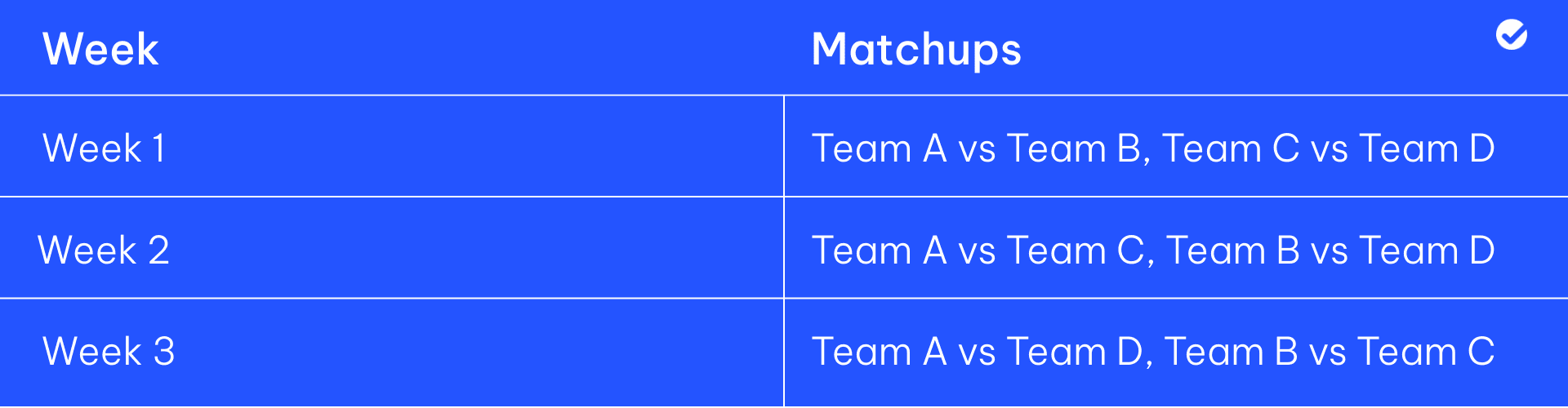
A round-robin format is one of the most common scheduling structures used in youth sports. In this format, every team plays against every other team at least once during the season. This approach creates balanced competition and ensures each team faces the same opponents.
Round-robin schedules are especially effective for smaller leagues where fairness and consistent play are priorities. If you want a deeper explanation of how this structure works, you can explore this guide on organizing a round robin tournament.
Example:
Single Elimination
Single elimination formats are typically used in tournaments or playoff scenarios. In this structure, teams are eliminated from the competition after losing one game, and the winners continue advancing until a champion is determined.
This format works well when leagues have limited time or field availability, since it requires fewer total games than round-robin scheduling.
Double Elimination and Hybrid Formats
Some leagues use double elimination or hybrid formats that combine round-robin play with playoff brackets. For example, teams might play a short round-robin regular season before moving into a single-elimination playoff tournament.
These formats can provide a balance between fairness and efficiency, allowing teams to play multiple opponents while still building toward a championship structure.
Step 2: Choose the Right Scheduling Format
Once your league structure is defined, the next step is choosing a scheduling format that works for your teams and season length. The format you choose determines how often teams play each other, how balanced the competition feels, and how easily your schedule can be managed throughout the season.
Different youth leagues use different formats depending on the number of teams, the available facilities, and whether the season includes playoffs or tournaments. Understanding the most common formats can help you choose one that fits your league’s goals.
Round Robin
A round-robin format is one of the most common scheduling structures used in youth sports. In this format, every team plays against every other team at least once during the season. This approach creates balanced competition and ensures each team faces the same opponents.
Round-robin schedules are especially effective for smaller leagues where fairness and consistent play are priorities. If you want a deeper explanation of how this structure works, you can explore this guide on organizing a round robin tournament.
Example:
Single Elimination
Single elimination formats are typically used in tournaments or playoff scenarios. In this structure, teams are eliminated from the competition after losing one game, and the winners continue advancing until a champion is determined.
This format works well when leagues have limited time or field availability, since it requires fewer total games than round-robin scheduling.
Double Elimination and Hybrid Formats
Some leagues use double elimination or hybrid formats that combine round-robin play with playoff brackets. For example, teams might play a short round-robin regular season before moving into a single-elimination playoff tournament.
These formats can provide a balance between fairness and efficiency, allowing teams to play multiple opponents while still building toward a championship structure.
Step 3: Account for Real-World Constraints
After choosing a scheduling format, the next step is accounting for the real-world factors that affect when and where games can be played. While a schedule may look balanced on paper, logistical constraints often require adjustments once the season begins.
One of the biggest challenges when creating a youth sports schedule is field availability. Many organizations share facilities with schools, community programs, or other sports leagues, which limits the availability of game slots. When multiple divisions rely on the same fields, organizers must distribute those time slots fairly across teams and age groups.
Another important factor is referee and volunteer availability. Coaches, officials, and volunteers often support multiple teams or divisions, which can create conflicts if games overlap.
League organizers should also consider:
School calendars and holidays
Community events or tournaments
Travel considerations for teams
Finally, the weather can disrupt even the best-planned schedules. While it’s impossible to control, leaving room for makeup games can help reduce the impact of cancellations.
As these constraints start to stack up, managing them manually can become difficult. Many leagues now rely on tools such as an AI sports schedule maker to help detect conflicts early and automatically generate balanced schedules.
Step 3: Account for Real-World Constraints
After choosing a scheduling format, the next step is accounting for the real-world factors that affect when and where games can be played. While a schedule may look balanced on paper, logistical constraints often require adjustments once the season begins.
One of the biggest challenges when creating a youth sports schedule is field availability. Many organizations share facilities with schools, community programs, or other sports leagues, which limits the availability of game slots. When multiple divisions rely on the same fields, organizers must distribute those time slots fairly across teams and age groups.
Another important factor is referee and volunteer availability. Coaches, officials, and volunteers often support multiple teams or divisions, which can create conflicts if games overlap.
League organizers should also consider:
School calendars and holidays
Community events or tournaments
Travel considerations for teams
Finally, the weather can disrupt even the best-planned schedules. While it’s impossible to control, leaving room for makeup games can help reduce the impact of cancellations.
As these constraints start to stack up, managing them manually can become difficult. Many leagues now rely on tools such as an AI sports schedule maker to help detect conflicts early and automatically generate balanced schedules.
Step 4: Build the Schedule (Manual vs Software)
Once your league structure, scheduling format, and logistical constraints are clearly defined, the next step is building the actual schedule. At this stage, organizers typically choose between creating the schedule manually or using scheduling software to automate much of the process.
Option 1: Manual Scheduling
Many leagues start by building their schedules in spreadsheets. This approach can work for smaller leagues with only a few teams and limited divisions. Organizers usually begin by listing all teams, assigning available game slots, and then rotating matchups according to the selected format.
However, manual scheduling can quickly become complicated as leagues grow. Adjusting a single game often requires reorganizing multiple matchups to avoid conflicts with fields, referees, or team availability. As the number of teams and divisions increases, maintaining balance across the schedule becomes much more difficult.
Option 2: Using Scheduling Software
Many leagues now use scheduling software to simplify this process. Instead of manually assigning every matchup, organizers can generate schedules automatically based on league size, available facilities, and preferred scheduling formats.
Platforms like TeamLinkt's schedule maker go beyond basic schedule generation by combining scheduling, team communication, and league management in one system. This allows organizers to create schedules, notify teams of changes, and manage league operations without juggling multiple tools.
Software-based scheduling can also make it easier to manage ongoing changes. If a game needs to be rescheduled due to weather or field availability, updates can be made quickly without having to rebuild large portions of the schedule.
For leagues managing multiple teams, divisions, and facilities, using scheduling software can significantly reduce the time and effort required to build and maintain a fair, organized season schedule.
Step 4: Build the Schedule (Manual vs Software)
Once your league structure, scheduling format, and logistical constraints are clearly defined, the next step is building the actual schedule. At this stage, organizers typically choose between creating the schedule manually or using scheduling software to automate much of the process.
Option 1: Manual Scheduling
Many leagues start by building their schedules in spreadsheets. This approach can work for smaller leagues with only a few teams and limited divisions. Organizers usually begin by listing all teams, assigning available game slots, and then rotating matchups according to the selected format.
However, manual scheduling can quickly become complicated as leagues grow. Adjusting a single game often requires reorganizing multiple matchups to avoid conflicts with fields, referees, or team availability. As the number of teams and divisions increases, maintaining balance across the schedule becomes much more difficult.
Option 2: Using Scheduling Software
Many leagues now use scheduling software to simplify this process. Instead of manually assigning every matchup, organizers can generate schedules automatically based on league size, available facilities, and preferred scheduling formats.
Platforms like TeamLinkt's schedule maker go beyond basic schedule generation by combining scheduling, team communication, and league management in one system. This allows organizers to create schedules, notify teams of changes, and manage league operations without juggling multiple tools.
Software-based scheduling can also make it easier to manage ongoing changes. If a game needs to be rescheduled due to weather or field availability, updates can be made quickly without having to rebuild large portions of the schedule.
For leagues managing multiple teams, divisions, and facilities, using scheduling software can significantly reduce the time and effort required to build and maintain a fair, organized season schedule.
Stay Connected
Leave your information below for monthly tips to grow and streamline your sports organization.
Stay Connected
Leave your information below for monthly tips to grow and streamline your sports organization.
Step 5: Publish, Communicate, and Manage Updates
The easiest way to avoid scheduling confusion is to publish schedules through a single centralized platform where teams, parents, and coaches can easily access the latest updates.
Most leagues publish schedules through a central platform where teams can quickly view game times, locations, and updates. Having a single source of truth helps prevent outdated versions from circulating among parents and coaches.
Schedule changes are also inevitable. Weather cancellations, field conflicts, and tournament adjustments often require games to be moved during the season. When updates are made in a centralized system and communicated clearly, organizers can reduce confusion and avoid managing dozens of individual messages.
Learn more about TeamLinkt’s Free Sports Team Management App
Step 5: Publish, Communicate, and Manage Updates
The easiest way to avoid scheduling confusion is to publish schedules through a single centralized platform where teams, parents, and coaches can easily access the latest updates.
Most leagues publish schedules through a central platform where teams can quickly view game times, locations, and updates. Having a single source of truth helps prevent outdated versions from circulating among parents and coaches.
Schedule changes are also inevitable. Weather cancellations, field conflicts, and tournament adjustments often require games to be moved during the season. When updates are made in a centralized system and communicated clearly, organizers can reduce confusion and avoid managing dozens of individual messages.
Learn more about TeamLinkt’s Free Sports Team Management App
When Spreadsheets Stop Working
Spreadsheets can work for small leagues, but they often become difficult to manage as leagues grow. Adding more teams, divisions, and facilities increases the number of variables that need to be balanced, and even small schedule changes can affect multiple games.
Rescheduling one matchup may require adjusting several others, while updates must still be communicated to coaches, players, and parents. Over time, maintaining schedules in youth sports manually can become time-consuming for league organizers.
This is often when leagues begin using dedicated management platforms like TeamLinkt, which help automate scheduling, communication, and other administrative tasks from a single system.
When Spreadsheets Stop Working
Spreadsheets can work for small leagues, but they often become difficult to manage as leagues grow. Adding more teams, divisions, and facilities increases the number of variables that need to be balanced, and even small schedule changes can affect multiple games.
Rescheduling one matchup may require adjusting several others, while updates must still be communicated to coaches, players, and parents. Over time, maintaining schedules in youth sports manually can become time-consuming for league organizers.
This is often when leagues begin using dedicated management platforms like TeamLinkt, which help automate scheduling, communication, and other administrative tasks from a single system.
FAQs
How long does it take to create a youth sports schedule?
Smaller leagues may build a schedule in a few hours, while larger leagues with multiple divisions and facilities may take much longer without scheduling tools.
What is the easiest way to schedule multiple youth sports teams?
Many leagues use a round-robin format or a sports schedule maker to automatically generate balanced matchups.
Can I create a youth sports schedule in Excel?
Yes, but spreadsheets can become difficult to manage as leagues grow and schedule changes occur.
How much does youth sports scheduling software cost?
Costs vary depending on the platform and league size. Some platforms, like TeamLinkt, offer free tools that allow leagues to create schedules and manage teams without upfront software fees.
How far in advance should a youth sports schedule be posted?
Ideally, families should have the full season schedule at least 4-6 weeks before the first game, enough time to plan work, travel and childcare around game days. The earlier you publish, the fewer last-minute conflicts you'll deal with.
FAQs
How long does it take to create a youth sports schedule?
Smaller leagues may build a schedule in a few hours, while larger leagues with multiple divisions and facilities may take much longer without scheduling tools.
What is the easiest way to schedule multiple youth sports teams?
Many leagues use a round-robin format or a sports schedule maker to automatically generate balanced matchups.
Can I create a youth sports schedule in Excel?
Yes, but spreadsheets can become difficult to manage as leagues grow and schedule changes occur.
How much does youth sports scheduling software cost?
Costs vary depending on the platform and league size. Some platforms, like TeamLinkt, offer free tools that allow leagues to create schedules and manage teams without upfront software fees.
How far in advance should a youth sports schedule be posted?
Ideally, families should have the full season schedule at least 4-6 weeks before the first game, enough time to plan work, travel and childcare around game days. The earlier you publish, the fewer last-minute conflicts you'll deal with.
Start Building a Better Youth Sports Schedule
Creating a youth sports schedule becomes much easier when leagues start with a clear structure, choose the right format, and account for real-world constraints like fields and availability. Taking the time to plan these elements early can help organizers build schedules that stay balanced and manageable throughout the season.
As leagues grow, many organizers move beyond spreadsheets and adopt scheduling tools to simplify updates and reduce administrative work. Platforms like TeamLinkt provide tools designed to help leagues generate schedules, manage teams, and keep everyone informed in one place.
Start Building a Better Youth Sports Schedule
Creating a youth sports schedule becomes much easier when leagues start with a clear structure, choose the right format, and account for real-world constraints like fields and availability. Taking the time to plan these elements early can help organizers build schedules that stay balanced and manageable throughout the season.
As leagues grow, many organizers move beyond spreadsheets and adopt scheduling tools to simplify updates and reduce administrative work. Platforms like TeamLinkt provide tools designed to help leagues generate schedules, manage teams, and keep everyone informed in one place.

Vince Ocampo
Marketing Specialist | TeamLinkt
Vince is a Marketing Specialist at TeamLinkt focused on content strategy, SEO, and AI-driven search in the youth sports space.
Vince Ocampo
Marketing Specialist | TeamLinkt
Vince is a Marketing Specialist at TeamLinkt focused on content strategy, SEO, and AI-driven search in the youth sports space.
Start Building Your League Schedule
Create a free account and generate sports schedules in minutes using TeamLinkt’s scheduling tools.
Your Next Season Starts Here
Join thousands of sports organizations that manage registration, scheduling, and communication in one place.
Your Next Season Starts Here
Join thousands of sports organizations that manage registration, scheduling, and communication in one place.
Sports
sports_basketball
sports_football
sports_baseball
sports_soccer
ice_skating
sports_baseball
sports_volleyball
sports_baseball
sports_rugby
sports_hockey
sports_cricket
pool
sports_gymnastics
star_shine
sports_esports
sports_gymnastics
sports_martial_arts
sports
artist
Programs
Product
Enroll & Register
Plan & Schedule